By Samuel Abasiekong-Abasiekong
Israel’s political future is approaching another decisive moment, with Prime Minister Benjamin Netanyahu facing a defining test of his political survival. The central question is whether the veteran leader can overcome public dissatisfaction over security failures, prolonged conflict, economic pressures and deep divisions within Israeli society to secure another term in office.
For Netanyahu, the stakes extend beyond winning an election. His political future is closely tied to his handling of the wars and security crises that have shaped Israel since the Hamas-led attacks of 7 October 2023, his relationship with coalition partners, his standing among right-wing voters and the unresolved corruption trial that has shadowed his leadership.
The opposition, meanwhile, faces a different challenge: turning public discontent into a coherent electoral alternative capable of winning enough seats in Israel’s parliamentary system to form a government.
Netanyahu’s chances cannot be measured by personal popularity alone. The decisive question is whether his Likud party and its potential allies can assemble a majority of at least 61 seats in the 120-member Knesset, Israel’s parliament.
The following feature examines the political forces shaping that contest, the incumbent’s advantages and vulnerabilities, and the scenarios that could determine who governs Israel next.
1. THE LATEST PICTURE: NETANYAHU FACES A DEADLOCKED ELECTION
Israel’s general election was held on Tuesday, 27 October 2026. As of Wednesday, 28 October, the vote-counting process is still underway, and the available results do not establish a clear winner capable of forming a government.
Reuters reported that exit polls indicated a closely contested race between Netanyahu’s political camp and the opposition led by former military chief Gadi Eisenkot. The projections suggested a setback for Netanyahu but did not conclusively remove him from contention.
The distinction is crucial: winning the most votes or parliamentary seats is not the same as securing the premiership. Israel operates under a parliamentary system in which the successful political leader must assemble a coalition capable of commanding a majority in the Knesset.
The 120-seat parliament requires at least 61 seats for a conventional majority government. With neither side apparently holding a guaranteed path to that threshold, coalition negotiations could prove as consequential as the election itself.
The latest reporting also indicates that Netanyahu’s Likud party was ahead of Eisenkot’s Yashar party in the partial count reported by the Associated Press, even as neither political bloc appeared to have secured the numbers needed to govern. That gives Netanyahu a possible advantage in the contest to become the largest party, but not necessarily a majority. AP News
2. WHO IS CHALLENGING NETANYAHU
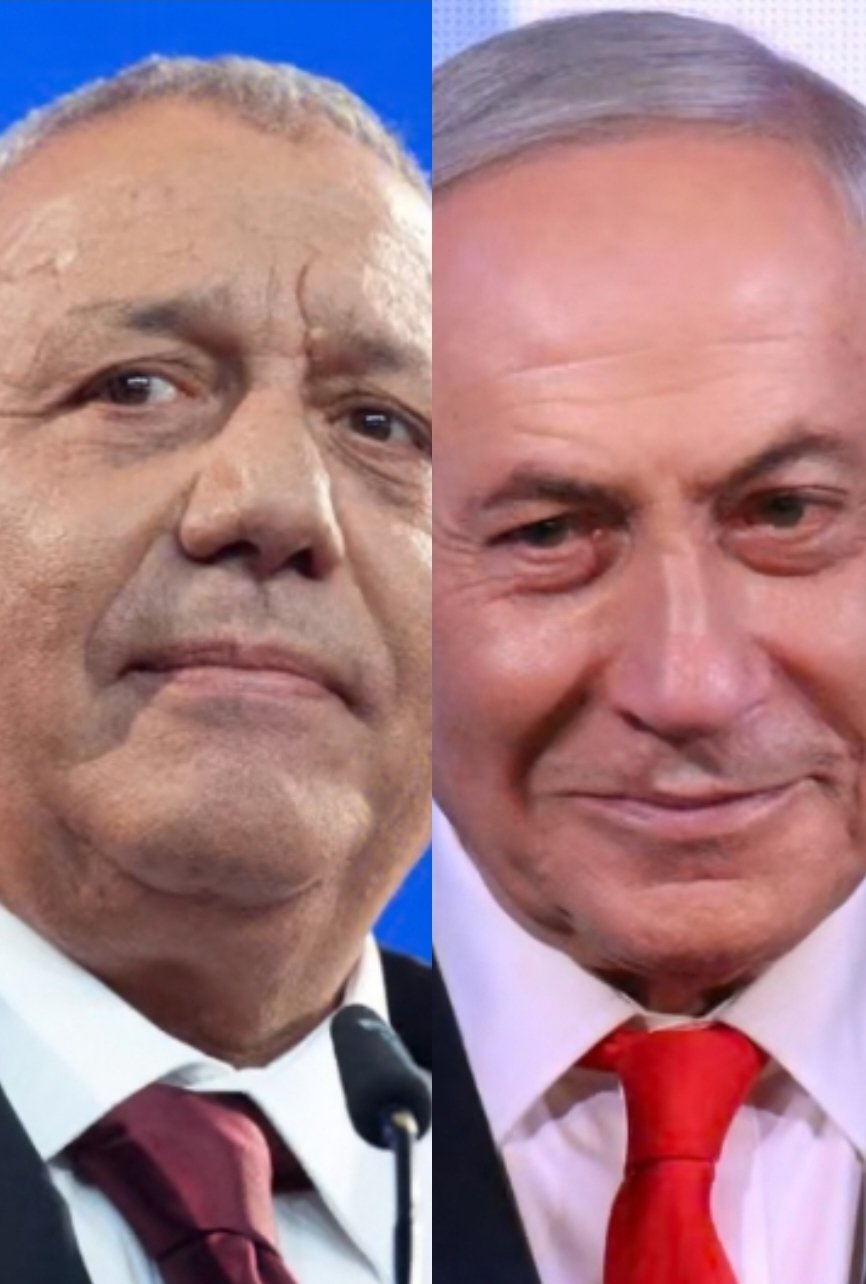
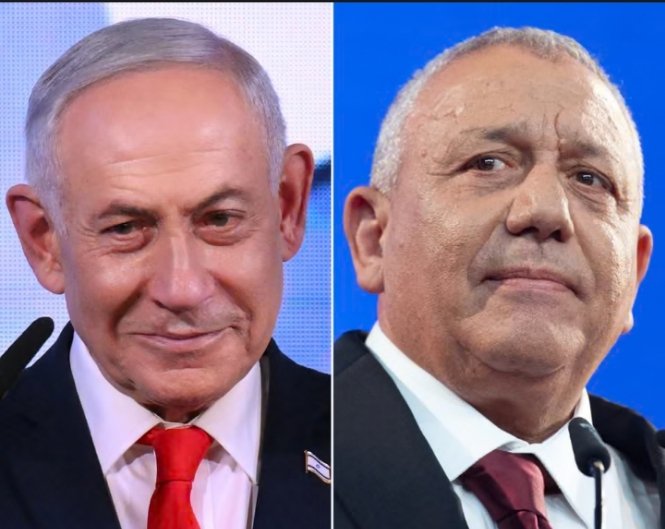
Incumbent Prime Minister, Benjamin Netanyahu
Netanyahu leads Likud and relies on a coalition of right-wing, far-right and ultra-Orthodox religious parties. His principal strength is the established political and organisational network behind his leadership.
Principal Opposition Challenger, Gadi Eisenkot
Eisenkot, a former chief of the Israel Defense Forces, heads the centrist Yashar party and has presented himself as an alternative to Netanyahu’s leadership and approach to national security.
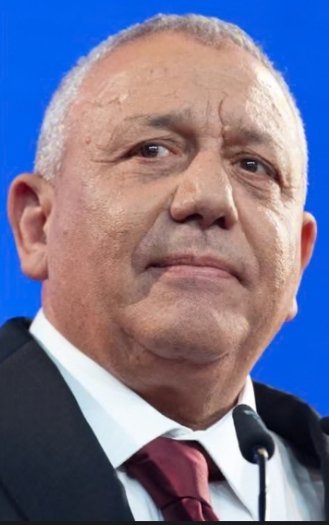
The election is not simply a referendum between two individuals. It is a contest between rival political coalitions with different positions on military service, judicial reform, religious influence, accountability for the October 2023 attacks and Israel’s future security strategy.
Other significant opposition figures and parties include former prime minister Naftali Bennett, Yair Lapid, Avigdor Liberman and Yair Golan. Their ability to cooperate after the election will determine whether opposition votes can be converted into an effective governing majority.
Netanyahu’s allies include the ultra-Orthodox parties Shas and United Torah Judaism, alongside the far-right Religious Zionism and Otzma Yehudit parties. Their support gives him an established coalition framework, but their demands can also limit his room for compromise.
3. WHAT THE LATEST VOTE COUNT TELLS US
The most important development is the difference between the early exit polls and the partial official results.
Israel Election: Partial Results
Central Elections Committee figures reported by The Times of Israel on 28 October 2026
Netanyahu-led bloc: 56 seats
Eisenkot-led opposition bloc: 48 seats
Arab-led parties: 16 seats
Seats required for a majority: 61 of 120
Partial results with approximately 66.2% of ballot boxes counted at 9:20 a.m. local time. Seat projections can change as counting continues.
These figures suggest that Netanyahu’s coalition has an advantage over the main opposition bloc in the partial count. However, the 56 seats attributed to his camp remain five short of a majority.
The opposition bloc’s 48 seats are further from the threshold, but its position could improve if it secures support from parties outside its immediate alliance.
The 16 seats projected for Arab-led parties make them potentially decisive in the parliamentary arithmetic. Yet their influence is constrained by the reluctance of major Jewish-led parties to enter a formal governing coalition with them.
The figures should not be interpreted as final results. They are a snapshot of an evolving count, and the eventual allocation of seats may differ.
4. NETANYAHU’S STRONGEST ADVANTAGE: THE POWER OF INCUMBENCY
Netanyahu remains one of Israel’s most experienced political operators. His long career, control of Likud’s established political machinery and relationships with religious and nationalist parties give him several advantages over challengers attempting to build a new governing coalition.
His campaign has also emphasised military achievements and the need for a strong right-wing government. Netanyahu has argued that Israel must continue confronting Iran and other security threats, presenting his leadership as essential during a period of regional instability.
That strategy appeals to voters who prioritise military deterrence, national security and continuity in foreign policy.
There is also an important parliamentary advantage: Netanyahu does not necessarily need to win the largest share of the national vote. He needs enough seats among parties willing to support him.
If smaller right-wing and religious parties perform well enough, he could potentially assemble a government despite failing to win an outright majority for Likud.
His immediate objective is therefore to preserve the existing coalition’s core and persuade any additional right-leaning lawmakers or parties to support him.
5. THE OCTOBER 7 SECURITY FAILURE REMAINS A a POLITICAL LIABILITY
One of the most consequential questions facing Netanyahu is accountability for the Hamas-led attacks of 7 October 2023.
The attacks exposed major failures in Israel’s intelligence, border security and preparedness. The subsequent war in Gaza and wider regional confrontation intensified the debate over whether the government had adequately protected Israeli citizens.
The election has consequently become a test of public confidence in Netanyahu’s judgement and leadership.
Opposition politicians argue that the country needs a change in leadership, stronger accountability and a different approach to national security. Eisenkot’s background as a former military chief gives him credentials that may appeal to voters who want security expertise without continuing Netanyahu’s political leadership.
Netanyahu’s challenge is that military action and political accountability are not necessarily judged in the same way. Some voters may credit his government for subsequent military operations while still blaming it for the failures that preceded the October 2023 attacks.
This creates a divided electorate: voters can support a forceful security policy without necessarily supporting the prime minister who directs it.
6. WAR FATIGUE, HOSTAGES AND REGIONAL SECURITY
The wars and regional confrontations have made security a central electoral issue, but they have also increased the political costs of prolonged conflict.
For some voters, continued military operations are necessary to prevent future attacks. For others, the costs of sustained warfare—including casualties, displacement, economic disruption and uncertainty over the country’s long-term security—strengthen the case for a different political approach.
Netanyahu’s insistence on maintaining a strong military posture may consolidate support among hard-line voters. At the same time, his opponents can argue that military strength must be accompanied by clear strategic objectives, effective diplomacy and credible plans for what follows the fighting.
The question is whether voters believe Netanyahu can deliver lasting security or whether they see his policies as prolonging instability.
The election does not provide a single, definitive answer to that question. Its divided outcome suggests that security concerns coexist with substantial disagreement over who should manage them.
7. THE ECONOMY AND THE COST OF LIVING
Security dominates the political debate, but economic pressures also matter.
Prolonged conflict can increase government expenditure, disrupt businesses, affect investment and tourism, and place additional pressure on public finances. The burden is unevenly distributed, with reservists, displaced communities, small businesses and households facing different forms of disruption.
For Netanyahu, the argument is that national security must come first and that his government has the experience to manage an exceptionally difficult regional environment.
For the opposition, the counterargument is that security cannot be separated from economic resilience, social cohesion and competent government.
Voters concerned about employment, taxation, public services and household costs may be less persuaded by claims of military success if they believe their living standards or economic prospects have deteriorated.
The final electoral outcome will help indicate whether these concerns have translated into sufficient support for political change. It cannot, by itself, establish that any one economic issue determined the result.
8. THE ULTRA ORTHKODOX MILITARY-SERVICE DISPUTE
Another potentially decisive issue is whether ultra-Orthodox Jewish men should continue receiving exemptions or deferments from compulsory military service.
The issue has become increasingly contentious amid the demands of sustained military mobilisation. Many secular and national-religious Israelis argue that the burden of service should be distributed more fairly.
Ultra-Orthodox parties, however, have strong incentives to protect their communities’ religious education systems and existing arrangements.
This creates a difficult dilemma for Netanyahu.
His religious coalition partners can provide crucial parliamentary support, but their demands over military-service exemptions may alienate voters who believe national security responsibilities should be shared more equally.
Eisenkot and other opposition politicians can use the dispute to present themselves as advocates of broader national responsibility. Yet they must still negotiate with parties whose positions differ on religion, the military and the future structure of Israeli society.
The issue could therefore influence not only the election result but also the stability of whichever government eventually emerges.
9. NETANYAHU’S CORRUPTION TRIAL AND INTERNATIONAL STANDING
Netanyahu’s political future is also affected by his ongoing domestic corruption trial, which he denies wrongdoing in, and the international legal controversy surrounding the International Criminal Court’s arrest warrant.
These issues are distinct and must not be conflated: domestic criminal proceedings and international judicial measures operate under different legal frameworks.
Politically, however, both contribute to the wider debate over leadership, accountability and Israel’s international relationships.
For Netanyahu’s opponents, the legal controversies reinforce their argument that Israel needs a change of leadership and a renewed focus on public trust.
His supporters may regard the proceedings as politically motivated or believe that security and national interests should take precedence over the legal disputes.
The controversies can therefore deepen existing political divisions rather than necessarily persuading voters from one camp to switch sides.
They also carry diplomatic implications. Israel’s relationships with the United States, European governments and other international partners are affected by debates over its conduct during the conflicts and the legal scrutiny facing its leadership.
10. THE ARAB PARTIES COULD HOLD THE BALANCE OF POWER
The performance of Arab-led parties may prove central to determining who governs Israel.
Partial results reported on Wednesday put these parties at a combined 16 seats, although the final allocation remained subject to the ongoing count. The Times of Israel
Their representation gives them potential leverage in a parliament where neither major political camp appears to have secured 61 seats independently.
However, the arithmetic is easier than the politics.
Netanyahu has ruled out relying on Arab parties to form his government. Major Jewish-led opposition parties also face political and ideological obstacles to entering a formal coalition with them.
An alternative arrangement could involve Arab parties supporting an opposition-led government from outside the coalition, abstaining in a confidence vote, or negotiating support for specific legislation. Such arrangements are politically sensitive and would require difficult negotiations.
If no viable arrangement can be reached, the result could be a prolonged stalemate rather than a decisive transfer of power.
11. THREE SCENARIOS THAT COULD DETERMINE NETANYAHU’S FUTURE
Scenario One: Netanyahu Forms Another Government
Plausible
Netanyahu preserves the support of Likud, the religious parties and the far right, then finds additional parliamentary support or a workable arrangement with other right-leaning politicians.
What it would mean: He remains prime minister, although coalition partners may demand concessions on military service, judicial policy, religion and security.
Scenario Two: Eisenkot Assembles an Alternative Government
Possible, But Difficult
The opposition coordinates its parties, attracts support from unaligned lawmakers and negotiates an arrangement involving Arab-led parties, whether through formal coalition participation or external parliamentary backing.
What it would mean: Netanyahu loses the premiership, and Israel begins a political transition centred on a different leadership and potentially a different approach to domestic governance.
Scenario Three: Deadlock And Another Election
Significant Risk
Neither camp can build a stable majority, and negotiations fail despite attempts by party leaders and the president to find a workable government.
What it would mean: Netanyahu could remain caretaker prime minister while the political system prepares for another election, prolonging uncertainty over domestic policy and regional diplomacy.
These are analytical scenarios, not predictions with assigned probabilities. Their feasibility depends on the final seat distribution, coalition commitments and negotiations that have yet to be completed.
12. WHAT HAPPENS NEXT UNDER ISRAEL’S POLITICAL SYSTEM
The official count and the subsequent coalition-building process are the next critical stages.
Israel’s president, Isaac Herzog, consults party representatives and selects the candidate considered best placed to form a government. That decision is not automatically determined by which party finishes first.
The designated candidate must then negotiate a viable coalition. Reporting on the election indicates that the initial period for forming a government is 28 days, with a possible 14-day extension. If the process fails, further opportunities or another election may follow under the applicable rules.
This process can take weeks. During that period, Netanyahu may remain in office as caretaker prime minister.
The practical consequence is that an election-night setback does not necessarily mean immediate removal from power. Equally, a lead in the partial count does not guarantee that Netanyahu will remain prime minister.
The decisive event will be the emergence or failure to emerge of a coalition with sufficient parliamentary support.
13. WHAT THE ELECTION MEANS FOR THE MIDDLE EAST
Israel’s political direction matters well beyond its borders.
A Netanyahu-led government would likely continue to emphasise military deterrence and a strong security posture toward Iran and armed groups hostile to Israel. His government would also face continuing questions over Gaza, relations with Arab states, the Palestinians and the country’s international standing.
An Eisenkot-led government could signal a change in leadership and a renewed emphasis on national unity, accountability and a different approach to domestic political disputes. However, a change of prime minister would not automatically resolve Israel’s security dilemmas or produce an immediate settlement with the Palestinians.
Any new administration would inherit the same underlying challenges: preventing further attacks, managing relations with regional powers, determining the future of Gaza, addressing the humanitarian consequences of conflict and navigating international pressure.
For the United States, European governments and Arab states, the outcome could influence the prospects for diplomatic engagement and regional de-escalation.
For African countries, including Nigeria, Israel’s political and security decisions can have indirect consequences through energy markets, international trade, diplomatic alignments and the wider stability of the Middle East.
The election’s broader significance is therefore not limited to who occupies the prime minister’s office. It concerns the political direction of a country whose decisions can affect an already volatile region.
14. FINAL ASSESSMENT: WHAT ARE NETANYAHU’S CHANCES?
The evidence available on 28 October 2026 supports a cautious conclusion: Netanyahu remains a serious contender to retain power, but his path to another government is uncertain.
Three Factors Support His Prospects.
First, his Likud-led bloc has taken the lead in the reported partial count. Second, he retains an established network of right-wing and religious coalition partners. Third, the opposition faces considerable difficulty converting its combined representation into a governing majority without negotiating with Arab-led parties or other lawmakers outside its immediate alliance.
Three Factors Weaken His Position.
The first is that his bloc remains short of the 61-seat majority. The second is the continuing public debate over the October 2023 security failures, the subsequent wars and government accountability. The third is that the opposition may still be able to construct an alternative arrangement, particularly if its parties coordinate effectively and secure external support.
The partial results do not justify declaring either Netanyahu’s victory or his defeat. The final seat distribution and the willingness of other parties to negotiate with him will be decisive.
For now, the most accurate assessment is that Netanyahu has a viable route to remaining prime minister, but he has not yet demonstrated that he can assemble a new governing majority.
The incumbent’s immediate challenge is no longer simply persuading voters. The election has moved into a second contest: persuading enough political parties and lawmakers to support his government.
The bottom line: Netanyahu could survive the election through coalition negotiations even if his bloc fails to secure a majority on its own. But if his opponents can overcome their differences and find a workable parliamentary arrangement, his long political dominance could face its most consequential challenge in years.
The next decisive milestone is the official final seat allocation, followed by President Herzog’s consultations and the negotiations that will determine who can command the Knesset.
™️©️ Samuel Abasiekong-Abasiekong, CEO/EiC www.efeederstation.com