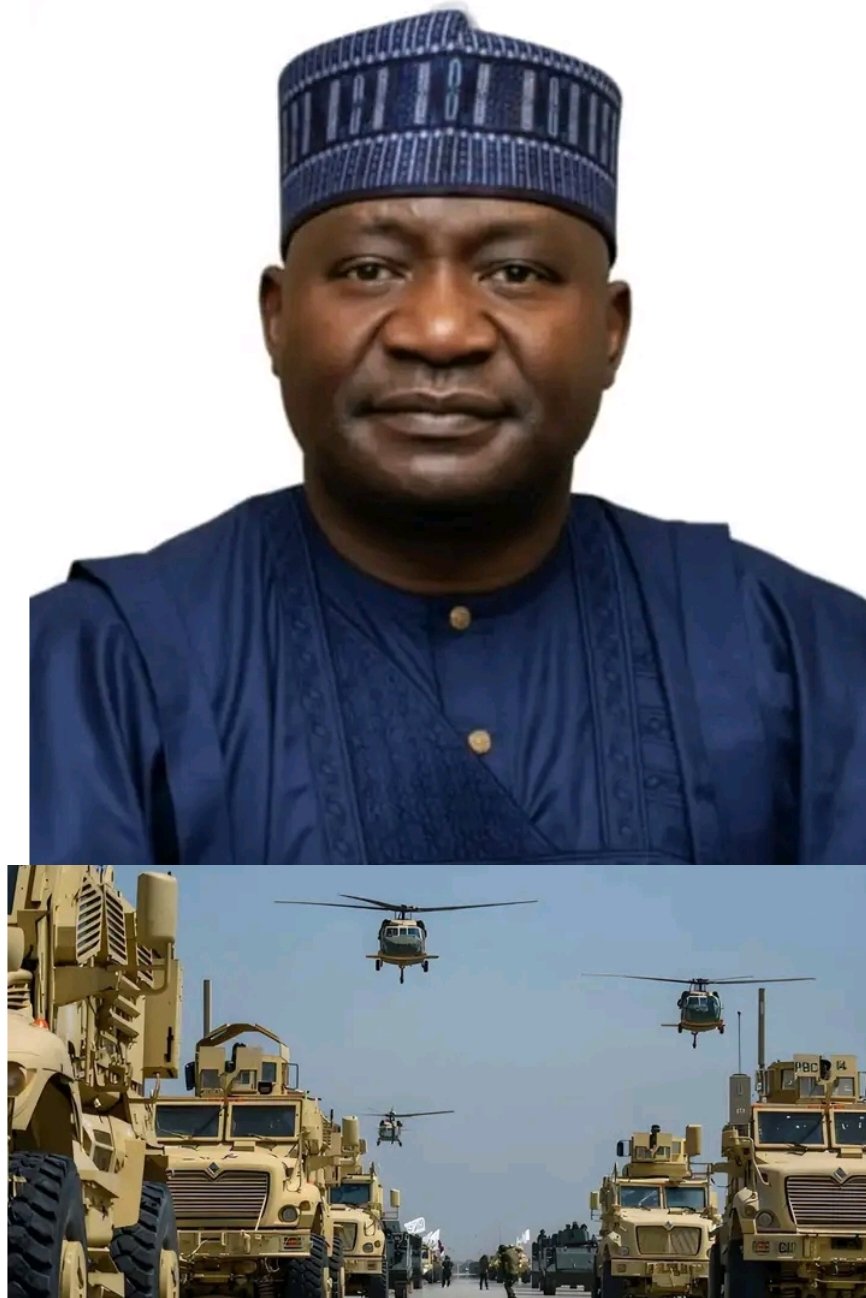
Nigeria’s Defence Minister, General Christopher Musa (rtd.), says the Federal Government will commence large-scale local production of military weapons and defence equipment within 12 months, in a major push to reduce dependence on foreign arms suppliers, strengthen national security and position the country as a defence equipment exporter in Africa.
Nigeria is preparing to take a major step towards developing an indigenous defence manufacturing industry, with the Federal Government announcing plans to begin large-scale domestic production of military hardware within the next year.
Defence Minister Christopher Musa made the announcement at the inaugural Africa International Defence Exhibition (AFRIDEX 2026), held at Eko Atlantic City, Lagos.
The exhibition brought together African governments, military officials, international defence manufacturers, security experts and technology companies to explore investment opportunities and strengthen cooperation in military technology.
Musa said the proposed manufacturing programme would prioritise the equipment requirements of the Nigerian Armed Forces while creating opportunities for exports to other African countries.
“Within the next year, Nigeria will commence large-scale local production of defence hardware to meet domestic requirements and support exports to other African countries,” the minister stated.
He described the initiative as an important step towards building a self-reliant defence industry, improving national security and positioning Nigeria as a contributor to Africa’s military manufacturing capacity.
DICON to Lead Nigeria’s Defence Manufacturing Drive
At the centre of the initiative is the Defence Industries Corporation of Nigeria (DICON), the government-owned institution responsible for developing the country’s indigenous defence manufacturing capabilities.
Established on August 1, 1964, DICON was created to reduce Nigeria’s dependence on foreign military equipment and develop local capacity for producing weapons, ammunition and other defence-related materials.
The institution received a significant legislative boost in November 2023 when President Bola Tinubu assented to the Defence Industries Corporation of Nigeria Act, 2023.
The new legislation repealed the previous legal framework and expanded DICON’s authority to establish and operate subsidiaries and ordnance factories for manufacturing, storing and distributing military equipment.
It also established the Defence Industry Technology, Research and Development Institute (DITRDI), designed to strengthen scientific research, technological innovation and the development of indigenous military hardware.
The framework provides a foundation for collaboration between defence researchers, military institutions, universities and private-sector manufacturers.
Nigeria Seeks to Reduce Dependence on Foreign Arms Suppliers
Nigeria has traditionally relied heavily on foreign countries for sophisticated military equipment, including aircraft, helicopters, armoured vehicles, surveillance systems, ammunition and other weapons.
Countries such as the United States, France, Italy and China have featured among Nigeria’s defence equipment suppliers.
Although international procurement remains important, the government believes stronger domestic manufacturing capabilities could reduce supply-chain vulnerabilities and improve the country’s ability to respond to security emergencies.
Local production could also reduce the time required to obtain spare parts, repair military equipment and replenish essential supplies.
For a country confronting insurgency, terrorism, banditry, kidnapping, separatist violence and other security threats, dependable access to military equipment is a major national security consideration.
Tinubu Woos International Defence Investors at AFRIDEX 2026
President Bola Ahmed Tinubu also used AFRIDEX 2026 to invite international defence manufacturers and African governments to establish strategic partnerships with Nigeria.
Represented by Senate President Godswill Akpabio at the opening ceremony on October 26, Tinubu advocated defence partnerships built on mutual trust, technological innovation and shared interests.
He urged African countries and international technology companies to explore opportunities in emerging defence technologies, including artificial intelligence and other advanced military systems.
The President maintained that defence cooperation should extend beyond the supply of military equipment to include technology transfer, technical expertise, training and the development of sustainable local industries.
Akpabio also emphasised the importance of strengthening Africa’s capacity to develop and maintain its own military equipment rather than depending excessively on external suppliers.
AFRIDEX 2026: Nigeria’s Bid to Become an African Defence Industry Hub
The inaugural Africa International Defence Exhibition was organised as a platform for connecting African governments, armed forces, international manufacturers, investors and defence technology innovators.
Hosted by DICON in partnership with international events company dmg events, the exhibition took place at Eko Atlantic City, Lagos, from October 26 to 29, 2026, according to its official event information.
Its programme covered five major areas: land, maritime, air, space and cyber defence.
The exhibition was designed to encourage international investment, military cooperation, technology transfer and the development of indigenous defence manufacturing capabilities across Africa. Afridex +2
The Economic Community of West African States (ECOWAS) also advocated stronger regional defence cooperation through indigenous industrial development.
The regional organisation stressed the importance of building African manufacturing capacity to address shared security challenges and reduce excessive dependence on external defence suppliers. ECOWAS
Can Nigeria Realistically Become a Major Defence Equipment Manufacturer?
Despite the government’s ambitious announcement, the transition from importing military equipment to manufacturing it on a large scale will require substantial investment, technological expertise and institutional reforms.
Nigeria already possesses some indigenous defence manufacturing experience through DICON and other domestic technology companies.
However, expanding production to meet the requirements of the Nigerian military while supplying other African countries will require considerably greater industrial capacity.
Several challenges must be addressed.
1. Funding and investment: Large-scale defence manufacturing requires significant capital for factories, machinery, research facilities and skilled personnel.
2. Technology transfer: Nigeria will need meaningful agreements with established international manufacturers to acquire technical knowledge, production expertise and advanced manufacturing processes.
3. Research and development: Sustained investment in engineering, electronics, artificial intelligence, robotics and materials science will be necessary to develop competitive military technology.
4. Quality control: Equipment manufactured locally must satisfy internationally recognised safety, reliability and operational standards.
5. Skilled manpower: Nigeria will need more defence engineers, scientists, technicians and specialised industrial workers.
6. Accountability: Transparent procurement, effective project supervision and proper management of public investments will be essential to prevent waste and ensure that announced projects translate into actual production.
What the Development Could Mean for Nigeria and Africa
If successfully implemented, domestic defence manufacturing could deliver economic and strategic benefits beyond the military sector.
It could create employment opportunities, encourage technological innovation, attract foreign investment and stimulate the growth of supporting industries.
Nigeria could also earn foreign exchange by exporting military equipment to African countries that currently depend on overseas manufacturers.
More importantly, a stronger indigenous defence industry could improve Nigeria’s strategic independence by reducing its vulnerability to foreign supply disruptions, export restrictions and changing international political relationships.
However, local production should complement rather than immediately replace international defence partnerships, particularly in areas requiring sophisticated technologies that Nigeria is still developing.
The 12-Month Deadline: What Nigerians Should Expect
Musa’s announcement has raised expectations about the future of Nigeria’s defence manufacturing industry.
However, the government has yet to publicly provide a comprehensive production roadmap specifying the factories to be expanded, the equipment to be manufactured first, the investment required, the production targets or the countries expected to become export destinations.
These details will be critical in determining whether the proposed programme can achieve its objectives within the announced timeframe.
The next 12 months will therefore be an important test of the government’s commitment to indigenous defence production.
For Nigeria, the ambition is bigger than manufacturing weapons. It is about developing the technological, industrial and research capacity to protect its sovereignty, strengthen its armed forces and become a major contributor to Africa’s defence industry.
Whether the initiative becomes a lasting industrial transformation or another ambitious government announcement will ultimately depend on implementation, investment, technology transfer and measurable production results.