By Samuel Abasiekong-Abasiekong
How the Okorocha court victory could deepen the power struggle involving Hope Uzodinma, Senate President Godswill Akpabio and FCT Minister Nyesom Wike, and expose the fragility of President Tinubu’s political alliance in the South-South.
SPECIAL POLITICAL ANALYSIS | OCTOBER 30, 2026
The unfolding political battle over the All Progressives Congress (APC) senatorial ticket for Imo West has developed into something much bigger than a contest between two former and serving governors.
It has exposed competing political interests within the ruling party and raised questions about the influence of President Bola Ahmed Tinubu over his political associates ahead of the January 16, 2027 presidential and National Assembly elections.
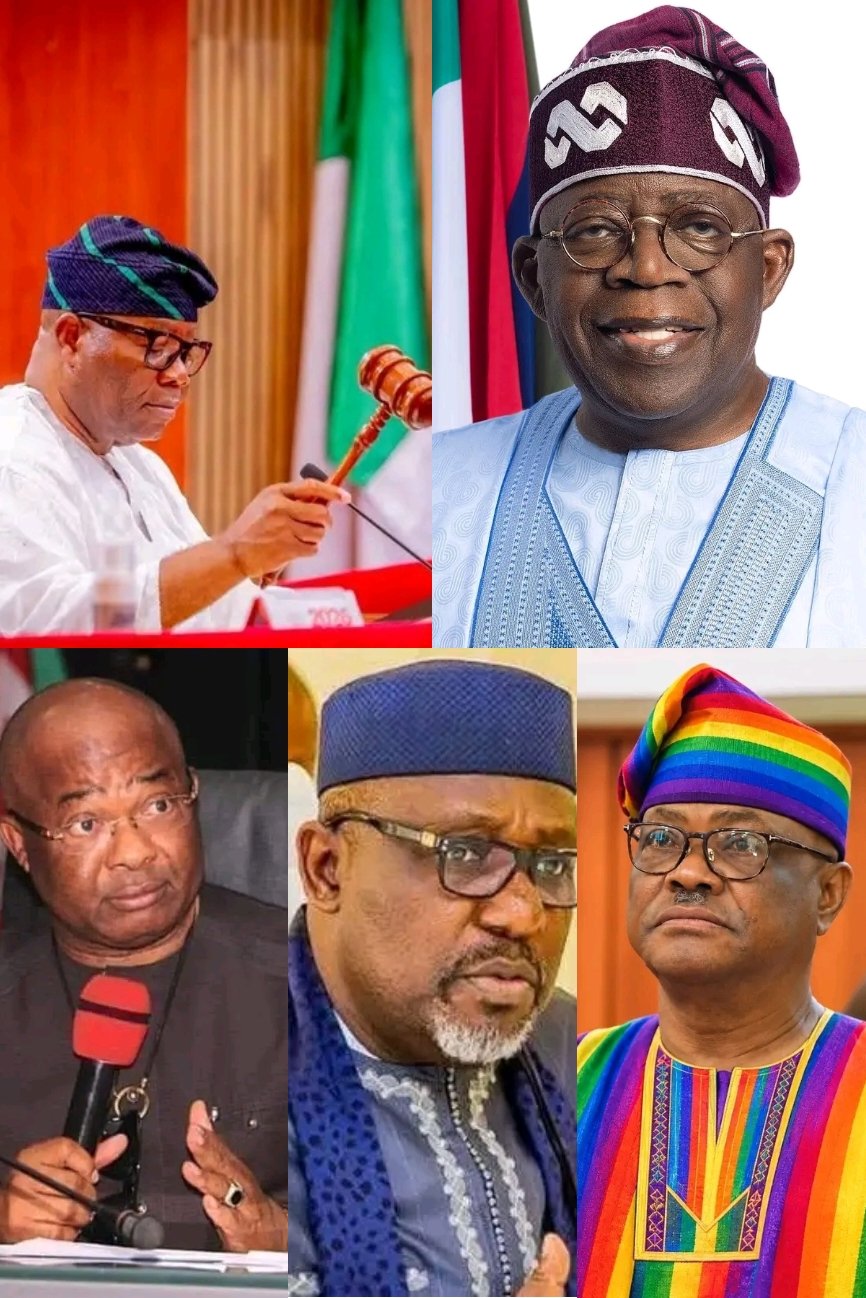
At the centre of the controversy are Imo State Governor Hope Uzodinma, former Governor Rochas Okorocha, Senate President Godswill Akpabio, FCT Minister Nyesom Wike and President Tinubu.
The most consequential question is whether a victory for Uzodinma at the Court of Appeal would further alienate powerful political figures whose support could matter significantly to Tinubu’s re-election prospects, particularly in the South-South.
The answer requires examining the judgment, the competing political interests and the difference between public political celebrations and actual electoral commitments.
1. WHAT EXACTLY DID THE FEDERAL HIGH COURT DECIDE ON OCTOBER 29, 2026
The controversy followed a judgment delivered on Thursday, October 29, 2026, by Justice Obiora Egwuatu of the Federal High Court, Abuja.
The case was filed by former Imo State Governor, Rochas Okorocha against the APC, INEC and Governor Hope Uzodinma.
The suit was registered as FHC/ABJ/CS/1854/2026.
Okorocha challenged INEC’s recognition of Uzodinma as the APC candidate for Imo West Senatorial District, arguing that he, rather than the incumbent governor, had won the party’s primary election conducted on May 18, 2026.
Justice Egwuatu ruled in Okorocha’s favour and made several important findings:
- Okorocha won the APC senatorial primary conducted on May 18, 2026.
- The publication of Uzodinma’s name as the winner of the primary was wrongful and unlawful.
- The APC’s documents supporting Uzodinma’s nomination contained material inconsistencies.
- Some of the documents were described by the judge as fabricated for the purpose of securing Uzodinma’s nomination.
- INEC was directed to replace Uzodinma’s name with Okorocha’s.
- Uzodinma was restrained from parading himself as the APC candidate for Imo West Senatorial District.
The judge also rejected the defence that Okorocha’s case was statute-barred, holding that the relevant cause of action arose when INEC published Uzodinma’s name on August 1, rather than on the date of the primary.
These findings are particularly damaging because the dispute is not simply about whether the APC followed its internal political arrangements. It concerns the integrity of the primary election and the validity of the nomination submitted to INEC.
The judgment relied heavily on documentary evidence, including the reports of INEC officials who monitored the primary.
THE CONFLICTING ELECTION FIGURES
One of the most remarkable aspects of the dispute is the difference between the results attributed to the two camps.
Candidates Reported votes:
Hope Uzodinma 230,464
Rochas Okorocha 1,098
These were the figures associated with the result recognising Uzodinma.
However, another document subsequently circulated, purportedly showing that Okorocha secured 150,780 votes.
The judge examined the conflicting records and found serious inconsistencies in the APC’s evidence.
Among the contradictions were claims that the primary was conducted through Option A4, a direct primary and a consensus arrangement.
These are materially different methods of selecting a candidate. The judge questioned how votes could have been allocated to aspirants if Uzodinma had actually emerged through consensus.
This was a central issue in the judgment. Punch Newspapers +2
2. CAN UZODINMA OVERTURN THE JUDGMENT AT THE the COURT OF APPEAL
Appeal expected
Yes. Uzodinma and the APC have the constitutional right to challenge the decision.
The Imo State Government has already rejected the judgment.
The Commissioner for Information, Declan Emelumba, described it as a travesty of justice and announced that the government would approach the Court of Appeal to seek its reversal.
The APC’s Imo State chapter has equally maintained that Uzodinma remains its candidate, pending its legal team’s examination of the judgment.
There are several possible outcomes.
Scenario A: The Court of Appeal upholds the judgment.
Okorocha’s victory would be reinforced. INEC would be required to recognise him as the APC candidate, subject to any further available legal proceedings.
This would represent a major political defeat for Uzodinma.
Scenario B: The Court of Appeal reverses the judgment.
Uzodinma could regain his recognition as the APC candidate, provided the appellate court sets aside the relevant orders and resolves the legal issues in his favour.
This would be a significant political victory for the governor and his supporters.
Scenario C: The Court of Appeal orders a fresh determination or makes consequential orders.
The dispute could become more complicated, depending on the grounds of appeal and the precise orders made.
One important point must be emphasised: an appeal being filed does not automatically mean that the judgment has been reversed. The lower court’s decision remains operative unless it is stayed, set aside or otherwise affected by a competent court order.
There is also an important legal distinction between the primary-election dispute and Uzodinma’s eligibility to leave office before the end of his governorship.
Section 183 of the 1999 Constitution prohibits a serving governor from holding another executive office or paid employment during his tenure. It does not expressly prohibit a governor from being nominated to contest a legislative election.
However, the timing of his proposed transition raises legitimate constitutional and political questions.
Uzodinma’s second term is expected to end in January 2028, while the 11th National Assembly is expected to begin in June 2027.
He would therefore have to address the question of when and how he would leave the governorship if elected senator.
3. WHY AKPABIO IS UNCOMFORTABLE WITH UZODINMA’S SENATE AMBITION
Senate President and APC political heavyweight from Akwa Ibom State.
Akpabio is seeking to retain his influence in the Senate and potentially return as Senate President in the 11th National Assembly.
The Uzodinma controversy cannot be fully understood without examining the emerging struggle over the Senate presidency.
Uzodinma’s reported ambition to enter the Senate is widely interpreted as more than a desire to return to legislative politics.
He previously represented Imo West in the Senate from 2011 to 2019. His proposed return could position him for another contest for the Senate presidency.
That possibility presents a political challenge to Akpabio.
Akpabio is not merely interested in having a Senate seat. He wants to retain the leadership position he currently occupies.
The competition became more visible when the Senate considered amendments to its standing orders that could affect eligibility for principal offices.
The proposed changes generated controversy because they appeared capable of restricting the ambitions of senators without the required consecutive legislative experience.
Following objections, the Senate rescinded the restrictive amendment.
Akpabio subsequently warned governors against abandoning their responsibilities to pursue other political offices.
At the October 14 inauguration of the APC presidential campaign council, he reportedly urged Tinubu to ensure that governors completed their constitutionally prescribed tenures before pursuing other offices.
The following day, senators also resolved that there would be no vacancy in the leadership of the 11th Senate.
These developments indicate that the tension is not simply a personal disagreement. It is a struggle over political succession, legislative influence and the distribution of power within the APC.
What happens if the Court of Appeal restores Uzodinma?
Akpabio could find himself confronting a politically stronger rival.
An Uzodinma who defeats Okorocha in court, secures the senatorial ticket and wins the January election could enter the 11th Senate with the political backing of powerful APC figures.
If he also enjoys the confidence of Tinubu, he could become a formidable contender for the Senate presidency.
For Akpabio, that would mean having to defend his position against a former senator who would also have recent experience as a state governor and chairman of the Progressive Governors’ Forum.
However, it would be premature to conclude that Uzodinma would automatically defeat Akpabio. The Senate presidency depends on the composition of the Senate, party calculations, regional arrangements and the President’s political preferences.
The fundamental issue is that both men have interests that may not always coincide.
4. THE WIKE FACTOR: Why the FCT Minister’s relationship with Uzodinma matters
FCT Minister and influential political mobiliser in Rivers State.
Wike’s political calculations are particularly important because of his influence among political structures in Rivers and his relationship with the Tinubu administration.
Wike’s disagreement with Uzodinma has added another dimension to the crisis.
The two politicians have reportedly fallen out over the Rainbow Coalition, the political mobilisation structure established by Wike to bring politicians from different parties together in support of Tinubu’s re-election.
Uzodinma, who chairs the Progressive Governors’ Forum, has opposed political arrangements that he believes could undermine APC candidates in the 2027 elections.
Wike, however, has defended his coalition, arguing that its purpose is to secure Tinubu’s second term, even if its members support different candidates in legislative and governorship elections.
In September 2026, Wike specifically questioned the governors’ opposition to his political arrangement.
He also argued that the experience of the 2023 elections demonstrated that voters could support Tinubu for president while voting for candidates from other political parties in legislative elections.
This is important because Wike is not necessarily committed to supporting every APC candidate.
His publicly stated position is that he is committed to Tinubu’s presidential re-election.
In fact, he has openly argued that presidential support should not automatically translate into support for every APC candidate.
THE OKOROCHA-WIKE CONNECTION
Following the Federal High Court judgment, an old video showing Wike celebrating alongside Okorocha resurfaced on social media.
The video generated considerable speculation because of the timing.
Some observers interpreted it as evidence of a political relationship that could work against Uzodinma.
However, there is an important distinction between an old video of two politicians celebrating together and proof that Wike personally engineered, financed or influenced the latest court judgment.
There is no established evidence that Wike influenced the judge or orchestrated the outcome.
Similarly, the available reporting identifies former APC National Chairman and former Kano State Governor Abdullahi Ganduje as someone who openly visited Okorocha to celebrate the judgment.
It does not establish that Akpabio personally organised or celebrated the judicial victory.
These distinctions matter. Political alliances and public appearances should not be presented as proof of involvement in a judicial process.
WOULD WIKE PREFER OKOROCHA TO UZODINMA
Politically, there are reasons Wike might welcome a setback for Uzodinma.
First, the two men have disagreed over the Rainbow Coalition.
Second, Uzodinma’s political ambition could potentially challenge the interests of established political figures in the 11th Senate.
Third, Wike has his own political interests in the South-South and is unlikely to welcome a political arrangement that diminishes his influence.
However, Wike’s relationship with Okorocha should not automatically be interpreted as an agreement to support Okorocha’s wider political ambitions.
The more significant consideration for Wike may be the removal or weakening of a political rival rather than the installation of a particular individual.
5. THE MOST IMPORTANT QUESTION: Would Akpabio and Wike still support Tinubu if Uzodinma wins at the Appeal Court?
This is where the controversy becomes particularly interesting.
President Tinubu’s relationship with his political allies is built around interests, influence, appointments, political accommodation and the distribution of power.
The President needs Akpabio in the National Assembly.
He also needs Wike’s political machinery, particularly in Rivers State and other parts of the South-South.
Uzodinma, meanwhile, is an important APC governor and a major political figure in the South-East.
The President therefore has to manage competing interests.
AKPABIO: Support for Tinubu versus the struggle for the Senate presidency
Akpabio’s political calculations may be different from Wike’s.
As Senate President, he has an institutional relationship with the Presidency.
His political survival and legislative influence are connected to the fortunes of the APC and the Tinubu administration.
However, he also has a personal interest in retaining the Senate presidency.
If Tinubu openly supports Uzodinma’s return to the Senate and subsequently favours him for Senate President, Akpabio could interpret that as a direct threat to his political future.
WOULD AKPABIO ABANDON TINUBU
Not necessarily, because there is a difference between opposing a presidential ally’s ambition and opposing the President himself.
Akpabio could continue supporting Tinubu’s re-election while quietly resisting Uzodinma’s ambition to become Senate President.
He could also negotiate with the President for assurances concerning the leadership of the 11th Senate.
But if he concludes that the Presidency is deliberately facilitating Uzodinma’s emergence at his expense, the relationship could become increasingly uncomfortable.
The danger for Tinubu is that a politically dissatisfied Senate President may become less enthusiastic about mobilising his political structures for the President’s re-election.
WIKE: A MORE COMPLICATED POLITICAL CALCULATION
Wike’s position is potentially more complicated because he is not an APC member occupying an elected APC political office.
He is a PDP politician serving in an APC-led federal administration.
His relationship with Tinubu is based substantially on political cooperation and the mutual advantages of their alliance.
Wike has repeatedly maintained that he is supporting Tinubu’s second-term ambition rather than committing himself to every APC candidate.
His Rainbow Coalition illustrates this distinction.
On October 27, 2026, the coalition unveiled its preferred candidates in Rivers State and reaffirmed its support for Tinubu’s re-election.
This demonstrates that Wike is building a political structure that can operate independently of the APC’s internal nomination arrangements.
Consequently, if Tinubu backs Uzodinma and the Appeal Court restores the governor’s senatorial ticket, Wike could still support Tinubu while continuing to oppose Uzodinma’s political interests.
That is not an impossible contradiction.
Wike’s political philosophy, as publicly expressed, allows him to support a presidential candidate from one political party while backing candidates from another party in legislative elections.
He could therefore mobilise Rivers voters for Tinubu without necessarily supporting Uzodinma’s political ambitions.
The real danger is not necessarily that Wike will withdraw his support for Tinubu. It is that his support could become conditional, selective and increasingly transactional.
6. IS TINUBU REALLY UZODINMA POLITICAL SPONSOR
This is an important question, but it requires a distinction between established political relationships and allegations.
Uzodinma is an important member of Tinubu’s political establishment.
He has supported the President’s administration, mobilised for the APC and played a national role as chairman of the Progressive Governors’ Forum.
At the October 14 inauguration of the APC presidential campaign council, Uzodinma was appointed secretary of the council.
He also publicly connected his political fortunes to Tinubu’s re-election, arguing that both the President and APC candidates would be on the ballot on January 16, 2027.
These are verifiable indications of political alignment.
There have also been reports suggesting that Tinubu is supportive of Uzodinma’s political transition to the Senate.
However, the claim that Tinubu personally sponsored or directed Uzodinma to abandon the governorship and contest the Senate seat should not be treated as an established fact without documentary evidence or a direct public confirmation.
Likewise, there is no verified public evidence establishing that Tinubu instructed Uzodinma to resign.
What has been reported is that Uzodinma has perfected plans to resign before his tenure expires if he wins the senatorial election.
This distinction is important because Tinubu could support Uzodinma’s political ambition without necessarily guaranteeing him the Senate presidency.
Presidential endorsement and actual control of the Senate are two different things.
7. WOULD THE CRISIS WEAKEN TINUBU’S CHANCES IN THE SOUTH-SOUTH
Potential political risk
The South-South is strategically important to Tinubu’s re-election calculations.
It comprises Akwa Ibom, Rivers, Cross River, Bayelsa, Delta and Edo states.
Two of the most influential political figures in the region are Akpabio and Wike.
Akpabio has considerable political influence in Akwa Ibom and within the APC’s South-South leadership structure.
Wike retains considerable political influence in Rivers State, built during his eight years as governor and through his continuing relationships with political stakeholders across party lines.
Their individual support could make a difference in voter mobilisation, political negotiations and the President’s electoral performance.
THE 2025 SOUTH-SOUTH ENDORSEMENT
In July 2025, APC stakeholders from the South-South endorsed Tinubu for a second term.
The meeting in Benin City was attended by Akpabio, several governors, ministers and other prominent APC figures.
The stakeholders passed a vote of confidence in Tinubu and the party’s regional leadership.
This demonstrated the importance the APC attached to maintaining a united regional political front.
But there is a difference between a regional endorsement and actual electoral delivery.
A politician can endorse a presidential candidate publicly without necessarily delivering all the votes associated with his political structure.
This is particularly relevant in Rivers State, where Wike has repeatedly demonstrated that his political machinery can mobilise voters independently of conventional party structures.
THREE POSSIBLE ELECTORAL CONSEQUENCES
First: If Akpabio becomes politically alienated from Tinubu.
The President could face difficulties maintaining a united APC structure in Akwa Ibom and parts of the South-South.
Akpabio’s political disagreements with Uzodinma could also complicate relationships within the party’s regional leadership.
Second: If Wike feels politically undermined by Tinubu’s relationship with Uzodinma.
Wike may continue supporting Tinubu but reduce his enthusiasm for broader APC political arrangements.
He could concentrate on securing victories for his preferred candidates while treating the presidential election as a separate political project.
Third: If both men become dissatisfied simultaneously.
This would be the most dangerous scenario for the President.
Although neither politician would necessarily defect from the Tinubu alliance, a reduction in their mobilisation efforts could create openings for opposition parties.
The consequences could extend beyond Rivers and Akwa Ibom to other states where their political relationships and influence are relevant.
However, there is currently no evidence that either Akpabio or Wike has withdrawn support for Tinubu’s re-election.
Indeed, Wike’s October 27 Rainbow Coalition event demonstrates that he is still publicly mobilising for the President.
8. WHAT IF THE APPEAL COURT RESTORES UZODINMA? Four possible political developments
The reversal of the Federal High Court judgment could produce consequences beyond the Imo West senatorial contest.
There are four developments worth watching.
1. THE STRUGGLE FOR THE SENATE PRESIDENCY COULD INTENSIFY
An Uzodinma victory would revive speculation about a contest between him and Akpabio for the Senate presidency.
2. Wike COULD STRENGTHEN HIS INDEPENDENT POLITICAL STRUCTURE
Rather than submit to the APC governors’ political arrangements, he could continue expanding the Rainbow Coalition.
3. TINUBU COULD FACE A DIFFICULT POLITICAL BALANCING ACT
He may have to reassure Akpabio that his ambition is not being sacrificed while simultaneously maintaining his relationship with Uzodinma.
4. OKOROCHA COULD BECOME A POLITICAL COUNTERWEIGHT TO UZODINMA
If Okorocha retains the ticket, his return to the Senate could also introduce another influential former governor into the calculations for the 11th National Assembly.
None of these outcomes is automatic. The eventual strength of each politician will depend on the senatorial election results, the composition of the next Senate and the political agreements reached before its inauguration.
9. WHAT IF OKOROCHA ULTIMATELY RETAINS THE TICKET
This scenario could also create an interesting political situation for Tinubu.
Okorocha has publicly commended the President following the judgment, describing it as evidence that the judiciary and other institutions can function independently.
He also acknowledged Tinubu’s role in providing an enabling environment for the institutions to operate.
That statement is politically significant.
It suggests that Okorocha is not presenting the judgment as a confrontation with Tinubu.
Rather, he is attempting to portray his victory as a vindication of democratic institutions.
He has also reportedly maintained his commitment to Tinubu’s re-election despite the dispute.
If Okorocha eventually becomes the APC candidate, Tinubu could find himself with another influential political figure in Imo State who might be useful in presidential mobilisation.
However, this would not automatically resolve the wider disagreements within the APC.
The conflict between Akpabio and Uzodinma over the 11th Senate presidency would remain a separate issue, while Wike’s disagreements with the Imo governor could also persist.
10. THE BIGGER ISSUE: Is Tinubu’s APC becoming a collection of competing political empires?
The Imo West controversy is a symptom of a wider problem within the ruling party.
The APC has several influential political figures whose interests do not always align.
Consider the competing ambitions:
- Tinubu wants re-election and a stable political structure.
- Akpabio wants to retain the Senate presidency.
- Uzodinma wants to return to the Senate and potentially emerge as a leading contender for its presidency.
- Wike wants to retain his political influence in Rivers State and across the South-South while mobilising support for Tinubu.
- Okorocha wants to reclaim his political relevance in Imo State and return to the National Assembly.
These interests can coexist as long as political compromises are maintained.
But when one political figure’s ambition threatens another’s position, the alliance becomes vulnerable.
The situation is made more complicated by the fact that Tinubu needs all these individuals for different political purposes.
The President cannot afford to alienate Akpabio because of the importance of the Senate.
He cannot easily discard Wike because of his influence in Rivers State and his cross-party mobilisation network.
Neither can he ignore Uzodinma, who remains an important APC governor and national party figure.
This is the political dilemma confronting the Presidency.
11. OUR ASSESSMENT: Will Akpabio and Wike sincerely deliver the South-South for Tinubu?
The most reasonable assessment is that both politicians could continue supporting Tinubu while pursuing their own interests against Uzodinma.
However, their support should not be confused with unconditional loyalty.
AKPABIO’SPOSITION:
His relationship with Tinubu is institutional as well as political. He has strong reasons to maintain that relationship.
But the possibility of Uzodinma emerging as a serious challenger for the Senate presidency could create resentment if the President appears to favour the Imo governor over him.
Akpabio may therefore support Tinubu’s re-election while protecting his own legislative interests.
MIKE’S POSITION:
Wike has already demonstrated that his political support for Tinubu does not require him to support every APC candidate.
His Rainbow Coalition is evidence of that approach.
He could therefore continue delivering presidential mobilisation while resisting Uzodinma’s political ambitions.
Nevertheless, if the dispute becomes a broader confrontation involving the Presidency and Wike’s political interests, the level of his commitment could become uncertain.
TINUBU’S POSITION:
The President must avoid allowing his political relationships to become competing centres of power.
Supporting Uzodinma’s ambition at the expense of Akpabio’s Senate leadership aspirations could create unnecessary friction.
Similarly, allowing the dispute with Wike to deteriorate could undermine the political cooperation that has helped the APC expand its influence beyond its traditional structures.
12. CONCLUSION: The real danger for Tinubu is not Okorocha’s victory but a divided political alliance
The judgment against Uzodinma has exposed a serious political fault line within the APC.
Although the immediate legal question concerns who won the May 18, 2026 APC senatorial primary, the wider political implications involve the future leadership of the Senate, the influence of the Presidency and the distribution of political power ahead of the 2027 elections.
If the Court of Appeal restores Uzodinma, Tinubu could celebrate a victory for an important political ally.
But that victory might come at a political cost if Akpabio interprets it as an attempt to weaken his position in the 11th Senate.
Wike could also become increasingly uncomfortable if Uzodinma continues to oppose his Rainbow Coalition and challenge his political influence.
Conversely, if the Appeal Court upholds Okorocha’s victory, Uzodinma could suffer a major political setback, while Akpabio and Wike might find the development favourable to their respective interests.
Yet the President could still maintain his relationship with Uzodinma without necessarily supporting every aspect of his political ambition.
The central question is whether Tinubu can successfully manage three powerful political interests without sacrificing the loyalty of any of them.
For a President seeking re-election, the danger is not necessarily that his political allies will openly abandon him.
It is that they could continue declaring support for him while quietly prioritising their individual political survival.
And in Nigerian politics, there is a significant difference between publicly endorsing a presidential candidate and committing one’s political machinery to deliver the votes.
The 2027 election may therefore test not only Tinubu’s popularity but also the durability of the political alliances that brought him to power in 2023.
Tinubu may ultimately discover that winning the loyalty of his political allies is just as important as winning the support of Nigerian voters.
Editorial note: The analysis distinguishes reported events from political interpretations. Claims that Tinubu personally sponsored Uzodinma’s senatorial ambition, or that Akpabio and Wike are coordinating against him, have not been independently established. The Appeal Court’s eventual decision and the politicians’ subsequent actions will be decisive in testing these political projections.
™️©️ Samuel Abasiekong-Abasiekong, CEO/EiC www.efeederstation.com